Weather for Frankston
Fair PM T-Storms Rain AM Showers Partly Cloudy
33,C 28,C 23,C 21,C 23,C
Tue Wed Thu Fri Sat
  • Decrease font size
  • Default font size
  • Increase font size

Garden Design - The process

garden plan We offer a complete garden design process, from initial consultation through to the ongoing consultation as your garden grows. Clive Abben is a garden designer with 30 years experience. In this page we will explain the design process and how it works. There are a number of steps to take, and some you might need whilst others might not be so necessary. Some of the steps can also be combined, for instance a planting plan can be combined with a final drawing for council planning drawings.
Once you have recognized the need for some help with your garden we will arrange the initial consultation. We will meet you on site and go over your needs. Sometimes a little practical advice is all that is needed, and if we feel that further advice is needed, either as a report, general concept design or more detailed designs, then we will give you an idea of the costs involved. The initial cost of consultation starts at $100, but will depend on the time needed and the distance to travel.

1. Client Consultation

meeting

2. Site Analysis

Survey drawing for site analysis

Once you have decided on a design, we will need to carry out a site survey. The complexity of this will depend on your site and needs. The picture on the left shows a site survey carried out by a professional surveyor. If you have a copy of your property title and any survey drawings it will save a lot of money on having your design carried out.

We will also go through a detailed questionnaire with you that will address both your aesthetic requirements as well as practical factors to consider such as placement of bins, washing lines etc.
we then look at the site and note any physical features that might affect the design such as exposure to wind and sun, soil type, drainage and the impact of neighbouring properties.

The designer then takes all that information and creates a drawing that combines your needs and wishes onto a drawing. The drawing can be either hand drawn or CAD (computer aided design). It is at this stage that changes or additions can be made, remember it is a lot easier and cheaper to do this now than when it is built! The design shows the placing of the elements that you want and their relationship with each other, but generally does not go into too much detail in case changes need to be made. This drawing is then used as the base for the final drawing, which is similar but has more detail>


3.Concept Design

Concept design

4. Final Drawing

garden drawing


This drawing contains more detail than the concept design. It includes what exact type of materials will be used, such as paving type, what type of garden edging; what type of stone; type of grass; type of mulch etc. It will also state how these materials will be used, for instance how thick is the mulch to be spread and what will the paving be laid on. If you are going to do your own landscaping or are going to get us to project manage your landscaping then this drawing might not be necessary as these decisions will be made as you go. If, however, you are going to get quotations from various contractors, the more detail the better so that they will quote from the same specifications.
The planting plan lists what plants will be used and where. It will have a plant schedule either on the drawing or attached to it. The plant schedule lists the plants, the quantities of plants to be used and what pot sizes to use. If you are not very knowledgeable about plants it is very wise to get a plan done as the planting is generally what really makes the garden. A well designed planting layout will not only look good, but should satisfy your needs in terms of water usage, maintenance requirements and lifestyle choices.

5. Planting Plan

planting plan

Further drawings

There are a number of other drawings that might be needed by regulations such as engineers drawings for retaining walls as well as other drawings such as elevations and perspectives in order to make the drawings easier to understand.

Construction drawings:

Engineering for retaining wall

If you are going to need retaining walls that are more than 1m high, then you need to get an engineer to draw up and specify the construction method. Retaining walls can be the most expensive part of a garden and the last thing you need is to have it fall down on you. I was working on a project in the North East of Melbourne many years ago and saw a retaining wall of about 3 meters high being constructed in a way that was obviously not engineered. I had a bet with my colleagues that it would not last 6 months. It lasted 3 weeks before starting to fall over!
You also might need construction drawings for buildings and structures you are putting on your property, check with your local council.
Construction drawings also help with the tendering process, so it is clear to all contractors how you expect the different aspects to be constructed.

Other projections include:
Elevations. These are drawings as if seen from the side, but contain no perspective in that objects do not get smaller the further away they are.

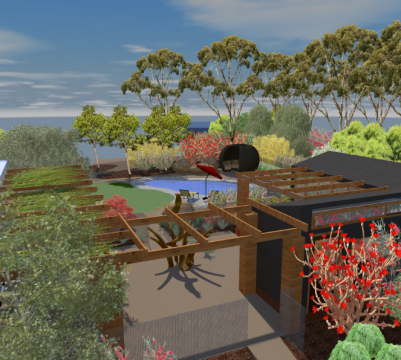
Perspectives: These drawings show the design as if it were seen by us, in that objects get smaller in the distance. The picture below shows a perspective drawing by one of my students.

perspective drawing

Projections:

axonometric projection


Abben Art is situated on the Mornington Peninsula but services Melbourne and surrounding areas.

SERVICING THE FOLLOWING AREAS

Portsea | Sorrento | Blairgowrie | Rye | Tootgarook | Rosebud | McCrae | Dromana | Safety Beach | Red Hill | Main Ridge | Shoreham | Merricks Hastings | Cape Schanck | Balnarring | Mt Martha | Mt Eliza | Mornington | Frankston | Seaford | Dandenong | Melbournre | South Yarra | Toorak | Brighton | Black Rock | Sandringham | Canterbury | Armadale | Caulfield | Hampton Park | Berwick | Glen Waverley | Pakenham | Langwarrin | Dingley | Mordialoc | Chadstone | Mt Waverley | Albert Park | South Melbourne